

Section 1: What Are Options?
- Definition of options - Call & Put options - Key terms: strike price, expiration date, premium, underlying asset
BEGINNER LEVEL
11 min read
Welcome to the exciting world of options! If you're new to this, don't worry. We're going to break down everything you need to know in a simple, straightforward way. Think of options as a powerful tool in your financial toolbox, but like any tool, you need to understand how to use it safely and effectively.
1. What Exactly Are Options? (And What's a Derivative?)


Imagine you're at a farmer's market. You see a vendor selling delicious strawberries, but they're not quite ripe yet. You know they'll be perfect in a week, and you're worried the price might go up, or they might sell out.
What if you could pay a small fee today to have the right, but not the obligation, to buy a certain amount of strawberries at a specific price next week? That's essentially what an option is!
In finance, an option is a contract that gives the buyer the right, but not the obligation, to buy or sell an underlying asset (like stocks, bonds, commodities, or currencies) at a predetermined price (called the strike price) on or before a specific date (the expiration date).
Because an option's value is derived from the value of something else (the underlying asset), options are classified as derivatives. Think of it this way: the value of your strawberry "option" contract depends on the price of the actual strawberries. If the strawberries become very expensive, your option becomes more valuable. If they become very cheap, your option might become worthless.
There are two fundamental types of options, and understanding their core difference is crucial:
Analogy: Think of a call option as putting a down payment on a house. You pay a small fee today to secure the right to buy that house at a set price for a limited time. If the house's value skyrockets, you can buy it at your agreed-upon lower price and immediately profit. If the house value drops, you can just walk away from your small down payment.
Analogy: Think of a put option as insurance for something you own, like your car. You pay a small premium (like your insurance premium) to protect your car's value. If something bad happens (the car's value drops significantly due to damage), your insurance (put option) gives you the right to "sell" it at a higher, agreed-upon value (the strike price) or receive compensation for the loss. If nothing bad happens, you just lose the small premium you paid for the insurance.
Underlying Asset: This is the actual asset that the option contract is based on. Most commonly, it's a stock (e.g., Apple stock, Tesla stock), but it can also be an index (like the S&P 500), a commodity (like oil or gold), or a currency.
Example: If you buy a call option on Apple (AAPL) stock, then AAPL is the underlying asset.
Strike Price (or Exercise Price): This is the predetermined price at which the buyer of the option can buy (for a call) or sell (for a put) the underlying asset.
Example: You buy an Apple call option with a $180 strike price. This means you have the right to buy Apple stock at $180 per share, no matter what its market price is, until the expiration date.
Expiration Date (or Maturity Date): This is the specific date on which the option contract expires. After this date, the option contract is no longer valid, and the right to buy or sell the underlying asset disappears. Options typically expire on the third Friday of the month, but weekly and even daily options are also available.
Example: Your Apple call option expires on July 19, 2024. After this date, you can no longer exercise your right.
Premium: This is the price you pay to buy an option contract. It's the cost of acquiring the right to buy or sell the underlying asset. The premium is typically quoted per share, but since one option contract usually represents 100 shares of the underlying asset, you multiply the quoted premium by 100 to get the total cost of one contract.
Example: If an Apple call option is quoted at a premium of $3.00, it means one share costs $3.00. Since one contract is for 100 shares, the total cost (premium paid) for one contract is $3.00 x 100 = $300.
Contract Size: Standard options contracts in the US represent 100 shares of the underlying stock. So, if you buy one option contract you are controlling 100 shares. This is where the leverage comes in!
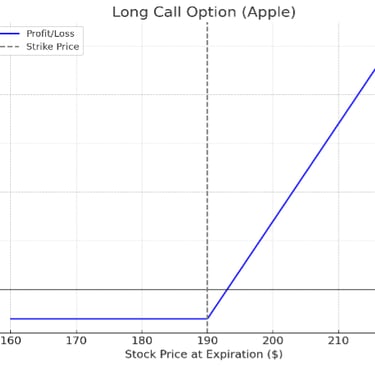
🔹Example 1: Long Call (You expect the stock to go UP)
Stock: Apple (AAPL)
Current Price: $180
Call Option: $190 strike price, expiring in 1 month
Premium (cost): $3 per share (options contract = 100 shares → $300 total)Scenario:
You believe Apple will announce strong earnings and the stock will rise.
You buy 1 call option with a $190 strike.
You pay $300 premium.
Two weeks later, Apple rises to $200.
Your call option is now worth $10 per share ($200 market price − $190 strike).
Your profit = ($10 − $3) × 100 = $700
✅ You made $700 profit on a $300 investment (over 200% return).
Let's say you believe XYZ stock, currently trading at $50 per share, is going to jump in price.
You could buy 100 shares of XYZ stock for $5,000.
OR, you could buy 1 XYZ Call Option with a strike price of $55, expiring in 3 months, for a premium of $2.00.
Your total cost: $2.00 x 100 shares = $200.
If XYZ jumps to $60, your call option gives you the right to buy 100 shares at $55. You could then immediately sell those shares at $60, making a profit of $5 per share ($60 - $55 = $5). Your total profit (before deducting the premium): $500. Your net profit: $500 - $200 (premium paid) = $300.
If XYZ stays at $50 or drops to $40, your option expires worthless. You lose only the $200 premium you paid.
Compare this to buying 100 shares: If XYZ drops to $40, you'd lose $1,000 ($50 - $40 = $10 per share loss x 100 shares).

2.2 Put Options: The Right to Sell
A put option gives the buyer the right to sell the underlying asset at the strike price, on or before the expiration date.
When would you buy a put? You buy a put option when you believe the price of the underlying asset will go down significantly before the expiration date. It's often used as an insurance policy.

3. Key Terms You Must Know
To truly understand options, you need to be familiar with these essential terms:
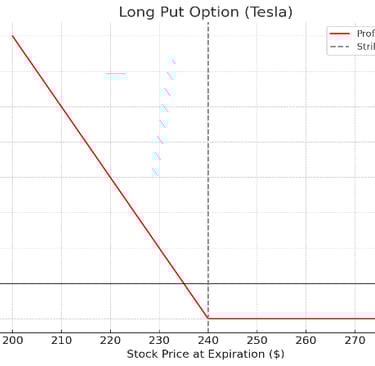
🔹 Example 2: Long Put (You expect the stock to go DOWN)
Stock: Tesla (TSLA)
Current Price: $250
Put Option: $240 strike price, expiring in 1 month
Premium (cost): $5 per share (options contract = 100 shares → $500 total)
Scenario:
You believe Tesla will face production issues and drop in value.
You buy 1 put option with a $240 strike.
You pay $500 premium.
Three weeks later, Tesla drops to $225.
Your put option is now worth $15 per share ($240 strike − $225 market).
Your profit = ($15 − $5) × 100 = $1,000
✅ You made $1,000 profit on a $500 investment (100% return).
Quick Review: Putting It All Together
This example briefly touches on why options are traded, which we'll explore in detail in the next section. For now, focus on understanding these core components.
2. The Two Main Option Types: Call Options & Put Options
2.1 Call Options: The Right to Buy
A call option gives the buyer the right to buy the underlying asset at the strike price, on or before the expiration date.
When would you buy a call? You buy a call option when you believe the price of the underlying asset will go up significantly before the expiration date.
Welcome to the exciting world of options! If you're new to this, don't worry. We're going to break down everything you need to know in a simple, straightforward way. Think of options as a powerful tool in your financial toolbox, but like any tool, you need to understand how to use it safely and effectively.
1. What Exactly Are Options? (And What's a Derivative?)

Imagine you're at a farmer's market. You see a vendor selling delicious strawberries, but they're not quite ripe yet. You know they'll be perfect in a week, and you're worried the price might go up, or they might sell out.
What if you could pay a small fee today to have the right, but not the obligation, to buy a certain amount of strawberries at a specific price next week? That's essentially what an option is!
In finance, an option is a contract that gives the buyer the right, but not the obligation, to buy or sell an underlying asset (like stocks, bonds, commodities, or currencies) at a predetermined price (called the strike price) on or before a specific date (the expiration date).
Because an option's value is derived from the value of something else (the underlying asset), options are classified as derivatives. Think of it this way: the value of your strawberry "option" contract depends on the price of the actual strawberries. If the strawberries become very expensive, your option becomes more valuable. If they become very cheap, your option might become worthless.
There are two fundamental types of options, and understanding their core difference is crucial:
Analogy: Think of a call option as putting a down payment on a house. You pay a small fee today to secure the right to buy that house at a set price for a limited time. If the house's value skyrockets, you can buy it at your agreed-upon lower price and immediately profit. If the house value drops, you can just walk away from your small down payment.
Analogy: Think of a put option as insurance for something you own, like your car. You pay a small premium (like your insurance premium) to protect your car's value. If something bad happens (the car's value drops significantly due to damage), your insurance (put option) gives you the right to "sell" it at a higher, agreed-upon value (the strike price) or receive compensation for the loss. If nothing bad happens, you just lose the small premium you paid for the insurance.
Underlying Asset: This is the actual asset that the option contract is based on. Most commonly, it's a stock (e.g., Apple stock, Tesla stock), but it can also be an index (like the S&P 500), a commodity (like oil or gold), or a currency.
Example: If you buy a call option on Apple (AAPL) stock, then AAPL is the underlying asset.
Strike Price (or Exercise Price): This is the predetermined price at which the buyer of the option can buy (for a call) or sell (for a put) the underlying asset.
Example: You buy an Apple call option with a $180 strike price. This means you have the right to buy Apple stock at $180 per share, no matter what its market price is, until the expiration date.
Expiration Date (or Maturity Date): This is the specific date on which the option contract expires. After this date, the option contract is no longer valid, and the right to buy or sell the underlying asset disappears. Options typically expire on the third Friday of the month, but weekly and even daily options are also available.
Example: Your Apple call option expires on July 19, 2024. After this date, you can no longer exercise your right.
Premium: This is the price you pay to buy an option contract. It's the cost of acquiring the right to buy or sell the underlying asset. The premium is typically quoted per share, but since one option contract usually represents 100 shares of the underlying asset, you multiply the quoted premium by 100 to get the total cost of one contract.
Example: If an Apple call option is quoted at a premium of $3.00, it means one share costs $3.00. Since one contract is for 100 shares, the total cost (premium paid) for one contract is $3.00 x 100 = $300.
Contract Size: Standard options contracts in the US represent 100 shares of the underlying stock. So, if you buy one option contract you are controlling 100 shares. This is where the leverage comes in!
🔹Example 1: Long Call (You expect the stock to go UP)
Stock: Apple (AAPL)
Current Price: $180
Call Option: $190 strike price, expiring in 1 month
Premium (cost): $3 per share (options contract = 100 shares → $300 total)Scenario:
You believe Apple will announce strong earnings and the stock will rise.
You buy 1 call option with a $190 strike.
You pay $300 premium.
Two weeks later, Apple rises to $200.
Your call option is now worth $10 per share ($200 market price − $190 strike).
Your profit = ($10 − $3) × 100 = $700
✅ You made $700 profit on a $300 investment (over 200% return).
Let's say you believe XYZ stock, currently trading at $50 per share, is going to jump in price.
You could buy 100 shares of XYZ stock for $5,000.
OR, you could buy 1 XYZ Call Option with a strike price of $55, expiring in 3 months, for a premium of $2.00.
Your total cost: $2.00 x 100 shares = $200.
If XYZ jumps to $60, your call option gives you the right to buy 100 shares at $55. You could then immediately sell those shares at $60, making a profit of $5 per share ($60 - $55 = $5). Your total profit (before deducting the premium): $500. Your net profit: $500 - $200 (premium paid) = $300.
If XYZ stays at $50 or drops to $40, your option expires worthless. You lose only the $200 premium you paid.
Compare this to buying 100 shares: If XYZ drops to $40, you'd lose $1,000 ($50 - $40 = $10 per share loss x 100 shares).

2.2 Put Options: The Right to Sell
A put option gives the buyer the right to sell the underlying asset at the strike price, on or before the expiration date.
When would you buy a put? You buy a put option when you believe the price of the underlying asset will go down significantly before the expiration date. It's often used as an insurance policy.

3. Key Terms You Must Know
To truly understand options, you need to be familiar with these essential terms:
🔹 Example 2: Long Put (You expect the stock to go DOWN)
Stock: Tesla (TSLA)
Current Price: $250
Put Option: $240 strike price, expiring in 1 month
Premium (cost): $5 per share (options contract = 100 shares → $500 total)
Scenario:
You believe Tesla will face production issues and drop in value.
You buy 1 put option with a $240 strike.
You pay $500 premium.
Three weeks later, Tesla drops to $225.
Your put option is now worth $15 per share ($240 strike − $225 market).
Your profit = ($15 − $5) × 100 = $1,000
✅ You made $1,000 profit on a $500 investment (100% return).
Quick Review: Putting It All Together
This example briefly touches on why options are traded, which we'll explore in detail in the next section. For now, focus on understanding these core components.
2. The Two Main Option Types: Call Options & Put Options
2.1 Call Options: The Right to Buy
A call option gives the buyer the right to buy the underlying asset at the strike price, on or before the expiration date.
When would you buy a call? You buy a call option when you believe the price of the underlying asset will go up significantly before the expiration date.