

Section 11: Protective Puts Strategy
Your Insurance Policy (Long Put)
2/1/20262 min read
Buying a protective put is a hedging strategy that allows you to protect the value of a stock you own from a significant downside move, similar to buying an insurance policy.
What it is: You own at least 100 shares of a stock, and you buy a put option on that same stock.
When to use it (Market View): You are bullish on the long-term prospects of a stock you own, but you are bearish or uncertain about its short-term performance. You want to limit your potential loss on your stock holding without selling the shares.
Why use it?
Defined Downside Protection: It sets a "floor" on your potential losses for the covered shares.
Flexibility: You retain your stock ownership and potential upside if the stock does not fall.
Capital Preservation: Helps protect your capital during volatile periods.
Protective Puts: Your Insurance Policy (Long Put)


Risk and Reward Profile:
Maximum Risk: Limited to the cost of the put option (premium paid) + (Stock Purchase Price - Put Option Strike Price). Your total potential loss is capped at the difference between your purchase price and the strike price, plus the premium.
Maximum Reward: Unlimited upside on your stock, minus the cost of the put. If the stock goes up, you simply lose the premium paid for the put (your insurance cost).
Break-Even Point: Stock Purchase Price + Premium Paid
Example: Buying a Protective Put
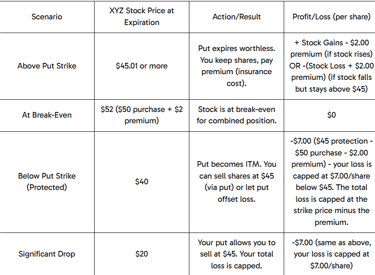
Let's say you own 100 shares of XYZ stock that you bought at $50 per share. XYZ is currently trading at $50. You believe in XYZ long-term, but you're worried about a potential dip next month due to an upcoming announcement.
You buy 1 XYZ $45 Put option expiring in 1 month for a premium of $2.00 per share (total cost: $2.00 x 100 shares = $200).
Important Considerations for Protective Puts:
Cost of Protection: The premium you pay for the put is an expense that reduces your overall return on the stock if it doesn't fall.
Time Decay: This is working against you, as the put option will lose value as time passes if the stock doesn't drop.
Strike Choice: A higher strike put offers more protection but costs more. A lower strike put offers less protection but costs less.
These three basic strategies form the bedrock of options trading. Practice understanding their mechanics, their risk/reward profiles, and when each is appropriate.

Buying a protective put is a hedging strategy that allows you to protect the value of a stock you own from a significant downside move, similar to buying an insurance policy.
What it is: You own at least 100 shares of a stock, and you buy a put option on that same stock.
When to use it (Market View): You are bullish on the long-term prospects of a stock you own, but you are bearish or uncertain about its short-term performance. You want to limit your potential loss on your stock holding without selling the shares.
Why use it?
Defined Downside Protection: It sets a "floor" on your potential losses for the covered shares.
Flexibility: You retain your stock ownership and potential upside if the stock does not fall.
Capital Preservation: Helps protect your capital during volatile periods.
Protective Puts: Your Insurance Policy (Long Put)

Risk and Reward Profile:
Maximum Risk: Limited to the cost of the put option (premium paid) + (Stock Purchase Price - Put Option Strike Price). Your total potential loss is capped at the difference between your purchase price and the strike price, plus the premium.
Maximum Reward: Unlimited upside on your stock, minus the cost of the put. If the stock goes up, you simply lose the premium paid for the put (your insurance cost).
Break-Even Point: Stock Purchase Price + Premium Paid
Example: Buying a Protective Put
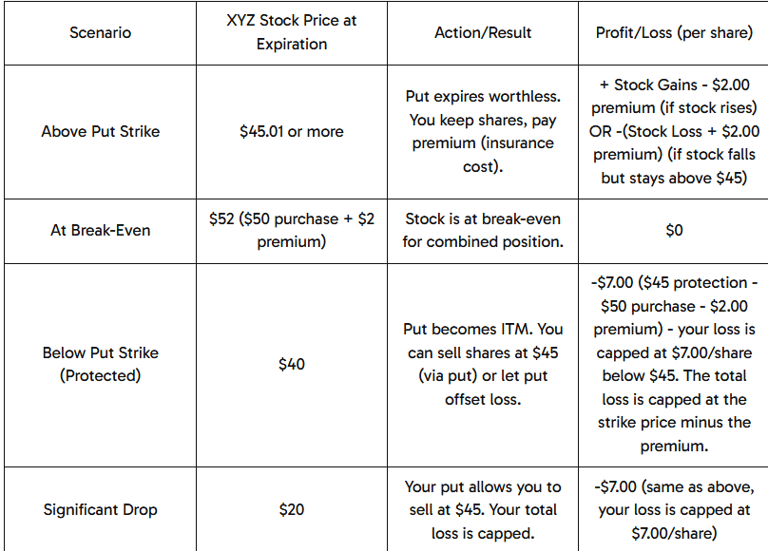
Let's say you own 100 shares of XYZ stock that you bought at $50 per share. XYZ is currently trading at $50. You believe in XYZ long-term, but you're worried about a potential dip next month due to an upcoming announcement.
You buy 1 XYZ $45 Put option expiring in 1 month for a premium of $2.00 per share (total cost: $2.00 x 100 shares = $200).
Important Considerations for Protective Puts:
Cost of Protection: The premium you pay for the put is an expense that reduces your overall return on the stock if it doesn't fall.
Time Decay: This is working against you, as the put option will lose value as time passes if the stock doesn't drop.
Strike Choice: A higher strike put offers more protection but costs more. A lower strike put offers less protection but costs less.
These three basic strategies form the bedrock of options trading. Practice understanding their mechanics, their risk/reward profiles, and when each is appropriate.