

Section 2: Why Trade Options?
Advantages of options trading - Risks and rewards - Comparing options to stocks and other derivatives
BEGINNER LEVEL
10/5/202512 min read
Now that we understand what options are, the next natural question is: Why would anyone use them? What advantages do they offer compared to simply buying and selling stocks? And what are the catches?
Options trading offers some unique benefits, primarily due to their nature as "leveraged instruments." However, with greater potential rewards often come greater risks. Let's explore both sides.
1. Advantages of Options Trading
Options, when used strategically, can provide several powerful benefits that aren't typically available with just stocks.
1.1 Leverage: Magnified Gains with Less Capital
This is arguably the biggest appeal of options. Leverage means you can control a large amount of the underlying asset (like 100 shares of a stock) with a relatively small amount of capital (the option premium).
How it works? As we saw, one standard option contract controls 100 shares. If a stock costs $100 per share, buying 100 shares would cost you $10,000. However, buying a call option on that stock might only cost $500. If the stock goes up, both the stock shares and the option contract will gain value. But because you invested much less capital in the option ($500 vs. $10,000), your percentage return on the option can be significantly higher.
Analogy: Imagine renting a luxury car for a weekend versus buying it. You get to experience the benefits of the car (potential gains from its movement) without committing all the capital required to own it outright.


1.2 Defined Risk (for Buyers)
When you buy an option (either a call or a put), your maximum potential loss is limited to the premium you paid for the contract. You cannot lose more than that amount, no matter how much the underlying asset moves against your prediction.
Benefit: This provides a clear "cap" on your potential downside, which can be comforting compared to owning stock, where your loss is limited only by the stock price going to zero (and your entire investment being lost).
Example: If you pay $300 for an option contract, the worst-case scenario is that you lose that $300 if the option expires worthless.
1.3 Income Generation
Options can be used to generate regular income from stocks you already own, or even from stocks you don't own (though this involves higher risk, as we'll discuss).
Example: Covered Calls: If you own 100 shares of a stock, you can sell a call option against those shares (this is called a "covered call"). You receive a premium instantly for selling this right. If the stock stays below the strike price, you keep the premium and the stock. This effectively generates income on your existing stock holdings. We will explore this strategy in detail later.


1.4 Hedging (Protecting Your Portfolio)
Options are excellent tools for managing risk and protecting your existing investments from adverse price movements. Think of them as an insurance policy for your stock portfolio.
Example: Protective Puts: If you own shares of a stock and are worried about a potential short-term dip, you can buy a put option on that stock. If the stock price falls, the value of your put option will increase, offsetting some or all of the loss in your stock shares. This is similar to paying a premium for car insurance to protect your vehicle's value.
1.5 Flexibility: Profiting in Any Market Condition
Unlike simply buying stocks (where you generally profit only if the stock goes up), options allow you to build strategies that can profit when the market: Goes Up (e.g., buying calls, selling puts) Goes Down (e.g., buying puts, selling calls) Stays Sideways (e.g., selling options with certain strategies) Becomes More Volatile (e.g., buying straddles) * Becomes Less Volatile (e.g., selling straddles)
This versatility makes options a powerful tool for sophisticated traders.
2. Risks and Rewards: The Double-Edged Sword
While the advantages are appealing, it's crucial to understand that options come with their own set of significant risks.
2.1 Rewards: The Potential for High Returns
As mentioned with leverage, a small move in the underlying asset's price can lead to a large percentage gain on your option investment. This is because the option premium is much smaller than the cost of the underlying shares.
Example (revisited):
Buying Stock: Invest $10,000 for 100 shares of XYZ at $100. If XYZ goes to $110, you gain $1,000 (10% return).
Buying Call Option: Invest $500 for a call option on XYZ at a $105 strike. If XYZ goes to $110, your option might be worth $700 or more, resulting in a 40%+ return ($200+ gain on a $500 investment).
2.2 Risks: The Potential for Significant Losses (and Beyond)
Time Decay (Theta): Options have a limited lifespan. As an option gets closer to its expiration date, it generally loses value. This is called "time decay" or "theta." If the underlying asset doesn't move in your favor quickly enough, the option can lose value simply due to the passage of time. This is a constant drag on the value of bought options.
Complexity: Options strategies can become very complex, quickly. Misunderstanding how a strategy works or how various factors (like volatility) affect an option's price can lead to unexpected losses.
Liquidity Risk: Some options on less popular stocks or with very far-out expiration dates may not be actively traded. This means it might be difficult to buy or sell them at a fair price when you want to.
High Probability of Losing the Entire Premium (for Buyers): While your maximum loss is defined when buying options, a high percentage of options contracts expire worthless. If the underlying asset doesn't move as expected or doesn't move enough by expiration, you lose 100% of the premium you paid.
Potentially Unlimited Loss (for Sellers of Naked Options): This is the most critical risk for beginners to understand. While buying options limits your loss, selling options (especially "naked" or uncovered options, meaning you don't own the underlying shares to cover the potential obligation) can expose you to unlimited losses.
Example: If you sell a naked call option and the stock skyrockets, you might be obligated to buy shares at a very high market price to deliver them at your lower strike price. This can lead to catastrophic losses far exceeding your initial premium received. We will strongly emphasize risk management and generally advise against selling naked options for beginners.
2.3 Comparing Options to Stocks and Other Derivatives
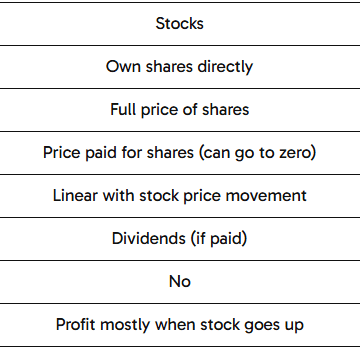
Let's put options into perspective by comparing them to other common investment vehicles:
3.1 Options vs. Stocks

3.2 Options vs. Other Derivatives (Briefly)
You'll hear about other derivatives like Futures and Forex (Foreign Exchange).
Futures Contracts: These are similar to options in that they are derivative contracts to buy or sell an asset at a predetermined price on a future date. However, futures carry an obligation to complete the transaction, unlike options which offer a right. This means futures traders face potentially unlimited losses and gains, and often require significant margin accounts. They are generally considered even riskier than options for beginners.
Forex (FX) Trading: This involves speculating on the exchange rates between different currencies. FX trading is highly leveraged and operates 24/5 globally. While it doesn't involve options directly in its simplest form, options on currencies do exist. Like futures, FX trading often involves significant leverage and can lead to rapid, substantial gains or losses.
Binary Options: are a simplified, "all-or-nothing" type of derivative. You bet on a simple "yes" or "no" proposition, typically related to whether an asset's price will be above or below a certain level at a specific time (e.g., "Will the stock price be above $100 in the next 15 minutes?"). If you're right, you get a fixed, predetermined payout (e.g., 70-85% of your investment). If you're wrong, you lose 100% of your investment.


Key takeaway: Options sit in a unique position. They offer more leverage and flexibility than stocks, but less obligation than futures. This makes them a versatile tool, but one that requires careful study and respect for their inherent risks.
Why they are generally NOT good for traders:
Fixed Payout Disadvantage: The payout if you're correct is almost always less than 100% of your initial investment (e.g., risking $100 to make $80). However, if you're wrong, you lose 100% of your investment. This creates an inherent mathematical disadvantage over time, making it very difficult to be consistently profitable.
All-or-Nothing Outcome: There are no partial profits or losses. It's a win or lose scenario, which removes the flexibility and nuanced risk management possible with traditional options.
Gambling-like Nature: The extremely short timeframes often available (minutes, even seconds) encourage highly speculative, gambling-like behavior rather than thoughtful investing.
Lack of Regulation and Scams: Many binary options brokers operate in unregulated or poorly regulated environments. This has historically led to numerous reports of fraud, manipulation, difficulty withdrawing funds, and unfair practices. Reputable financial authorities generally advise against them.
Conflict of Interest: Often, the broker acts as the counterparty to your trade (meaning your loss is their gain), creating a direct conflict of interest that is not in the trader's best interest.
Now that we understand what options are, the next natural question is: Why would anyone use them? What advantages do they offer compared to simply buying and selling stocks? And what are the catches?
Options trading offers some unique benefits, primarily due to their nature as "leveraged instruments." However, with greater potential rewards often come greater risks. Let's explore both sides.
Options, when used strategically, can provide several powerful benefits that aren't typically available with just stocks.
How it works? As we saw, one standard option contract controls 100 shares. If a stock costs $100 per share, buying 100 shares would cost you $10,000. However, buying a call option on that stock might only cost $500. If the stock goes up, both the stock shares and the option contract will gain value. But because you invested much less capital in the option ($500 vs. $10,000), your percentage return on the option can be significantly higher.
When you buy an option (either a call or a put), your maximum potential loss is limited to the premium you paid for the contract. You cannot lose more than that amount, no matter how much the underlying asset moves against your prediction.
Benefit: This provides a clear "cap" on your potential downside, which can be comforting compared to owning stock, where your loss is limited only by the stock price going to zero (and your entire investment being lost).
Example: If you pay $300 for an option contract, the worst-case scenario is that you lose that $300 if the option expires worthless.
Options can be used to generate regular income from stocks you already own, or even from stocks you don't own (though this involves higher risk, as we'll discuss).
Example: Covered Calls: If you own 100 shares of a stock, you can sell a call option against those shares (this is called a "covered call"). You receive a premium instantly for selling this right. If the stock stays below the strike price, you keep the premium and the stock. This effectively generates income on your existing stock holdings. We will explore this strategy in detail later.
Unlike simply buying stocks (where you generally profit only if the stock goes up), options allow you to build strategies that can profit when the market: Goes Up (e.g., buying calls, selling puts) Goes Down (e.g., buying puts, selling calls) Stays Sideways (e.g., selling options with certain strategies) Becomes More Volatile (e.g., buying straddles) * Becomes Less Volatile (e.g., selling straddles)
This versatility makes options a powerful tool for sophisticated traders.
Time Decay (Theta): Options have a limited lifespan. As an option gets closer to its expiration date, it generally loses value. This is called "time decay" or "theta." If the underlying asset doesn't move in your favor quickly enough, the option can lose value simply due to the passage of time. This is a constant drag on the value of bought options.
Complexity: Options strategies can become very complex, quickly. Misunderstanding how a strategy works or how various factors (like volatility) affect an option's price can lead to unexpected losses.
Liquidity Risk: Some options on less popular stocks or with very far-out expiration dates may not be actively traded. This means it might be difficult to buy or sell them at a fair price when you want to.
High Probability of Losing the Entire Premium (for Buyers): While your maximum loss is defined when buying options, a high percentage of options contracts expire worthless. If the underlying asset doesn't move as expected or doesn't move enough by expiration, you lose 100% of the premium you paid.
Potentially Unlimited Loss (for Sellers of Naked Options): This is the most critical risk for beginners to understand. While buying options limits your loss, selling options (especially "naked" or uncovered options, meaning you don't own the underlying shares to cover the potential obligation) can expose you to unlimited losses.
Example: If you sell a naked call option and the stock skyrockets, you might be obligated to buy shares at a very high market price to deliver them at your lower strike price. This can lead to catastrophic losses far exceeding your initial premium received. We will strongly emphasize risk management and generally advise against selling naked options for beginners.
You'll hear about other derivatives like Futures and Forex (Foreign Exchange).
Futures Contracts: These are similar to options in that they are derivative contracts to buy or sell an asset at a predetermined price on a future date. However, futures carry an obligation to complete the transaction, unlike options which offer a right. This means futures traders face potentially unlimited losses and gains, and often require significant margin accounts. They are generally considered even riskier than options for beginners.
Forex (FX) Trading: This involves speculating on the exchange rates between different currencies. FX trading is highly leveraged and operates 24/5 globally. While it doesn't involve options directly in its simplest form, options on currencies do exist. Like futures, FX trading often involves significant leverage and can lead to rapid, substantial gains or losses.
Binary Options: are a simplified, "all-or-nothing" type of derivative. You bet on a simple "yes" or "no" proposition, typically related to whether an asset's price will be above or below a certain level at a specific time (e.g., "Will the stock price be above $100 in the next 15 minutes?"). If you're right, you get a fixed, predetermined payout (e.g., 70-85% of your investment). If you're wrong, you lose 100% of your investment.
Why they are generally NOT good for traders:
Fixed Payout Disadvantage: The payout if you're correct is almost always less than 100% of your initial investment (e.g., risking $100 to make $80). However, if you're wrong, you lose 100% of your investment. This creates an inherent mathematical disadvantage over time, making it very difficult to be consistently profitable.
All-or-Nothing Outcome: There are no partial profits or losses. It's a win or lose scenario, which removes the flexibility and nuanced risk management possible with traditional options.
Gambling-like Nature: The extremely short timeframes often available (minutes, even seconds) encourage highly speculative, gambling-like behavior rather than thoughtful investing.
Lack of Regulation and Scams: Many binary options brokers operate in unregulated or poorly regulated environments. This has historically led to numerous reports of fraud, manipulation, difficulty withdrawing funds, and unfair practices. Reputable financial authorities generally advise against them.
Conflict of Interest: Often, the broker acts as the counterparty to your trade (meaning your loss is their gain), creating a direct conflict of interest that is not in the trader's best interest.
Key takeaway: Options sit in a unique position. They offer more leverage and flexibility than stocks, but less obligation than futures. This makes them a versatile tool, but one that requires careful study and respect for their inherent risks.
1. Advantages of Options Trading
This is arguably the biggest appeal of options. Leverage means you can control a large amount of the underlying asset (like 100 shares of a stock) with a relatively small amount of capital (the option premium).
1.1 Leverage: Magnified Gains with Less Capital
Analogy: Imagine renting a luxury car for a weekend versus buying it. You get to experience the benefits of the car (potential gains from its movement) without committing all the capital required to own it outright.

1.2 Defined Risk (for Buyers)
1.3 Income Generation
1.4 Hedging (Protecting Your Portfolio)
Options are excellent tools for managing risk and protecting your existing investments from adverse price movements. Think of them as an insurance policy for your stock portfolio.
Example: Protective Puts: If you own shares of a stock and are worried about a potential short-term dip, you can buy a put option on that stock. If the stock price falls, the value of your put option will increase, offsetting some or all of the loss in your stock shares. This is similar to paying a premium for car insurance to protect your vehicle's value.
1.5 Flexibility: Profiting in Any Market Condition
2. Risks and Rewards: The Double-Edged Sword
While the advantages are appealing, it's crucial to understand that options come with their own set of significant risks.
2.1 Rewards: The Potential for High Returns
As mentioned with leverage, a small move in the underlying asset's price can lead to a large percentage gain on your option investment. This is because the option premium is much smaller than the cost of the underlying shares.
Example (revisited):
Buying Stock: Invest $10,000 for 100 shares of XYZ at $100. If XYZ goes to $110, you gain $1,000 (10% return).
Buying Call Option: Invest $500 for a call option on XYZ at a $105 strike. If XYZ goes to $110, your option might be worth $700 or more, resulting in a 40%+ return ($200+ gain on a $500 investment).
2.2 Risks: The Potential for Significant Losses (and Beyond)
3. Comparing Options to Stocks and Other Derivatives
Let's put options into perspective by comparing them to other common investment vehicles:
3.1 Options vs. Stocks

3.2 Options vs. Other Derivatives (Briefly)

