

Section 7: Understanding Short Selling
Understanding the short selling. - Short Selling VS Put Options
BEGINNER LEVEL
10/7/20257 min read
Understanding who is in the market and the basic types of positions they take is crucial before you dive into specific options strategies. Every trade involves different participants with varying goals, and recognizing these fundamental stances will help you better interpret market movements.
Understanding Short Selling: Profiting When Prices Fall (Stocks)
It's important to understand how traders can make money when a stock's price goes down. This is called "going long" when you buy a stock (hoping it goes up) and "going short" when you sell a stock (hoping it goes down).
Short selling is the opposite of buying a stock. Instead of buying low and selling high, you are selling high first, with the intention of buying low later.
Here's how it works:
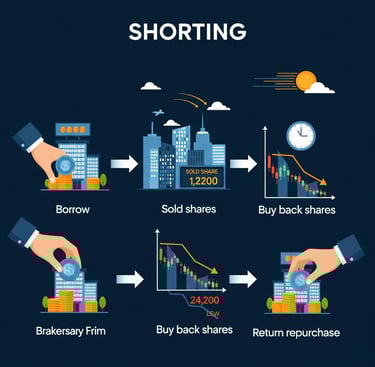
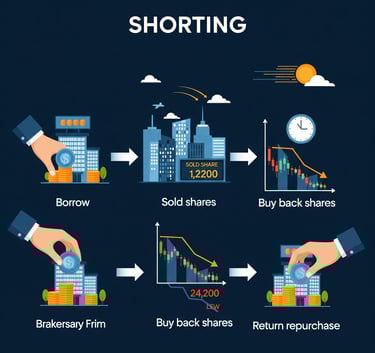
1.Borrow Shares: When you short a stock, you don't actually own the shares. Instead, you borrow shares from your brokerage firm. The brokerage firm lends you shares that are owned by other clients (who might not even know their shares are being lent out).
Analogy: Imagine borrowing a friend's valuable antique vase. You don't own it, but you have possession of it.
2. Sell Borrowed Shares: Immediately after borrowing the shares, you sell them on the open market at the current market price. This is where you get your initial cash from the "high" sale.
Analogy: You immediately sell your friend's borrowed vase to someone else, hoping to buy it back cheaper later.
3. Wait for Price to Drop: You then wait, hoping the stock's price falls, just as you predicted.
4. Buy Back Shares: If the price does fall, you buy back the same number of shares on the open market at the new, lower price. This is your "buy low" part.
5. Return Shares: You then return the shares to your brokerage firm (who lent them to you).
6. Buy Back Shares: If the price does fall, you buy back the same number of shares on the open market at the new, lower price. This is your "buy low" part.
Analogy: The antique vase market crashes, and you buy the same type of vase back for much less money.
Profit: Your profit is the difference between the higher price you sold the borrowed shares for and the lower price you bought them back for, minus any borrowing fees or commissions.

Short Selling Example:
Let's say Company B stock is trading at $100 per share, and you believe it's overvalued and will fall.
You short 100 shares of Company B:
You borrow 100 shares from your broker.
You immediately sell those 100 borrowed shares on the market for $100 each, bringing in $10,000.
Company B stock falls:
A few weeks later, Company B announces bad news, and its stock price drops to $80 per share.
You cover your short:
You buy back 100 shares of Company B on the market for $80 each, costing you $8,000.
You return these 100 shares to your broker.
Your Profit: You received $10,000 from the initial sale and spent $8,000 to buy them back. Your gross profit is $2,000 ($10,000 - $8,000).
While short selling allows you to profit from falling prices, it carries a very high risk, potentially even higher than buying stock:
Unlimited Loss Potential: When you buy a stock, your maximum loss is the amount you paid (the stock can only go to zero). When you short a stock, there's theoretically no limit to how high the stock price can go. If the stock moves against you and skyrockets instead of falling, your losses can be enormous, potentially exceeding your initial investment. You still have to buy the shares back to return them to your broker, no matter the price.
Example: In the Company B example, if the stock jumped to $150 instead of falling, you would lose $50 per share ($15,000 to buy back vs. $10,000 received initially), resulting in a $5,000 loss. If it went to $200, you'd lose $10,000!
Margin Calls: Because of this unlimited risk, brokers require you to keep a certain amount of capital (called "margin") in your account when you short sell. If the stock price rises significantly, your broker will issue a "margin call," demanding you deposit more money to cover the potential losses. If you can't, they will forcibly close your position, locking in your losses.
Borrowing Costs: You might have to pay interest on the borrowed shares, especially for hard-to-borrow stocks.
Short Selling and Options (Connecting the Dots):
This is where put options become incredibly powerful.
Buying a Put Option: Allows you to profit from a falling stock price without the unlimited risk of short selling. When you buy a put, your maximum loss is limited to the premium you paid. If the stock unexpectedly rallies, you just lose the premium – you don't face a margin call or a theoretically unlimited loss like you would with short selling.
The "Insurance" Aspect: This limited risk is why buying puts is often compared to buying insurance. You pay a defined premium for potential protection or profit from a downside move.
Understanding short selling provides crucial context for taking bearish positions in the market, especially when we compare it to how options allow you to do the same with defined risk.


Understanding who is in the market and the basic types of positions they take is crucial before you dive into specific options strategies. Every trade involves different participants with varying goals, and recognizing these fundamental stances will help you better interpret market movements.
It's important to understand how traders can make money when a stock's price goes down. This is called "going long" when you buy a stock (hoping it goes up) and "going short" when you sell a stock (hoping it goes down).
Short selling is the opposite of buying a stock. Instead of buying low and selling high, you are selling high first, with the intention of buying low later.
Here's how it works:
1.Borrow Shares: When you short a stock, you don't actually own the shares. Instead, you borrow shares from your brokerage firm. The brokerage firm lends you shares that are owned by other clients (who might not even know their shares are being lent out).
Analogy: Imagine borrowing a friend's valuable antique vase. You don't own it, but you have possession of it.
2. Sell Borrowed Shares: Immediately after borrowing the shares, you sell them on the open market at the current market price. This is where you get your initial cash from the "high" sale.
Analogy: You immediately sell your friend's borrowed vase to someone else, hoping to buy it back cheaper later.
3. Wait for Price to Drop: You then wait, hoping the stock's price falls, just as you predicted.
4. Buy Back Shares: If the price does fall, you buy back the same number of shares on the open market at the new, lower price. This is your "buy low" part.
5. Return Shares: You then return the shares to your brokerage firm (who lent them to you).
6. Buy Back Shares: If the price does fall, you buy back the same number of shares on the open market at the new, lower price. This is your "buy low" part.
Analogy: The antique vase market crashes, and you buy the same type of vase back for much less money.
Profit: Your profit is the difference between the higher price you sold the borrowed shares for and the lower price you bought them back for, minus any borrowing fees or commissions.
Short Selling Example:
Let's say Company B stock is trading at $100 per share, and you believe it's overvalued and will fall.
You short 100 shares of Company B:
You borrow 100 shares from your broker.
You immediately sell those 100 borrowed shares on the market for $100 each, bringing in $10,000.
Company B stock falls:
A few weeks later, Company B announces bad news, and its stock price drops to $80 per share.
You cover your short:
You buy back 100 shares of Company B on the market for $80 each, costing you $8,000.
You return these 100 shares to your broker.
Your Profit: You received $10,000 from the initial sale and spent $8,000 to buy them back. Your gross profit is $2,000 ($10,000 - $8,000).
While short selling allows you to profit from falling prices, it carries a very high risk, potentially even higher than buying stock:
Unlimited Loss Potential: When you buy a stock, your maximum loss is the amount you paid (the stock can only go to zero). When you short a stock, there's theoretically no limit to how high the stock price can go. If the stock moves against you and skyrockets instead of falling, your losses can be enormous, potentially exceeding your initial investment. You still have to buy the shares back to return them to your broker, no matter the price.
Example: In the Company B example, if the stock jumped to $150 instead of falling, you would lose $50 per share ($15,000 to buy back vs. $10,000 received initially), resulting in a $5,000 loss. If it went to $200, you'd lose $10,000!
Margin Calls: Because of this unlimited risk, brokers require you to keep a certain amount of capital (called "margin") in your account when you short sell. If the stock price rises significantly, your broker will issue a "margin call," demanding you deposit more money to cover the potential losses. If you can't, they will forcibly close your position, locking in your losses.
Borrowing Costs: You might have to pay interest on the borrowed shares, especially for hard-to-borrow stocks.
Short Selling and Options (Connecting the Dots):
This is where put options become incredibly powerful.
Buying a Put Option: Allows you to profit from a falling stock price without the unlimited risk of short selling. When you buy a put, your maximum loss is limited to the premium you paid. If the stock unexpectedly rallies, you just lose the premium – you don't face a margin call or a theoretically unlimited loss like you would with short selling.
The "Insurance" Aspect: This limited risk is why buying puts is often compared to buying insurance. You pay a defined premium for potential protection or profit from a downside move.
Understanding short selling provides crucial context for taking bearish positions in the market, especially when we compare it to how options allow you to do the same with defined risk.
1 Understanding Short Selling: Profiting When Prices Fall (Stocks)